
- Visitor information
- About us
- Exhibitions
- Temporary Exhibitions
- Permanent Exhibitions
- Past Exhibitions
- 2024/2025 - Life with Honey
- 2024/2025 - WANDERINGS - Lili Ország in Kiscell
- 2024 - Light & City
- 2022 - Gábor Gerhes: THE ATLAS
- 2019/2020 - Shine! - Fashion and Glamour
- 2019 - 1971 – Parallel Nonsynchronism
- 2018 – Your Turn!
- 2018 – Still Life
- 2017 – LAMP!
- 2017 – Tamás Zankó
- 2017 – Separate Ways
- 2017 – Giovanni Hajnal
- 2017 – Image Schema
- 2017 – Miklós Szüts
- 2016 – "Notes: Wartime"
- 2016 – #moszkvater
- 2015 – Corpse in the Basket-Trunk
- 2015 – PAPERwork
- 2015 – Doll Exhibition
- 2014 – Budapest Opera House
- 2013 – Wrap Art
- 2012 – Street Fashion Museum
- 2012 – Riding the Waves
- 2012 – Buda–Pest Horizon
- 2011 – The Modern Flat, 1960
- 2010 – FreeCikli
- 2008 – Drawing Lecture on the Roof
- 2008 – Fashion and Tradition
- 2004 – Mariazell and Hungary
- Virtual museum
- What's happening?
Temporary exhibitions
Category:
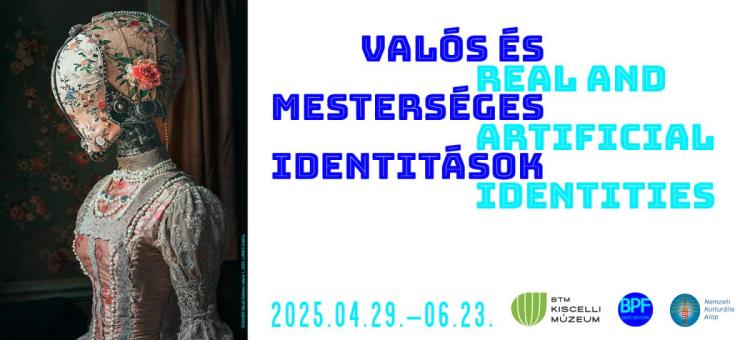
Curators: Veronika Molnár, Rita Somosi
Location: Oratory
The rise of AI-based imaging software is clearly opening a new chapter in the history of photography and visual culture, but does AI post-photography signal the end of human image-making—or the beginning of a new golden age? The artists in Real and Artificial Identities explore this question through the lens of portraiture. The exhibition presents a diverse range of works, from analogue photographs to portraits generated by artificial intelligence. Real and digitally created faces alternate on the walls, blurring the boundaries between the physical and the virtual, the human and the machine.
When photography first emerged, it was seen as a threat to painting—but rather than killing the medium, it catalyzed the birth of avant-garde art. Similarly, the relationship between technology and art has led to some of the most important breakthroughs of the 20th century: from the algorithmic compositions created by computer art pioneers in the 1960s, to the transformative impact of the internet and Photoshop on both art and media. Today, physical and digital spaces are increasingly merging, and human and machine intelligence are beginning to converge. The AI revolution of recent years—and the rapid spread of tools like Midjourney, Stable Diffusion, and DALL·E—has placed powerful image-making capabilities not just in the hands of artists, but in those of everyday users. While the long-term effects remain to be seen, one thing is clear: AI-generated images are proliferating at a staggering rate. In just the year and a half following the rise of this software, more AI images were created than photographs in the entire first 150 years of the medium’s history.
The Hungarian artists selected in the open call—including Szelina Bodócs, Luca Gőbölyös and Zoltán Tombor—approach these developments from a variety of perspectives and using diverse techniques. Together, they reflect on questions of identity and authorship in the age of AI. What does authenticity mean when reality and fiction are increasingly indistinguishable? How are biases embedded in AI systems, and how do these mirror broader social stereotypes? What defines beauty in an era where algorithms shape our aesthetic standards? And will AI transform the traditional role of portraiture as a record of individual identity? Real and Artificial Identities at the Kiscelli Museum brings these questions to the forefront—inviting viewers to engage with the shifting boundaries of representation, technology, and the self.
COMING SOON...
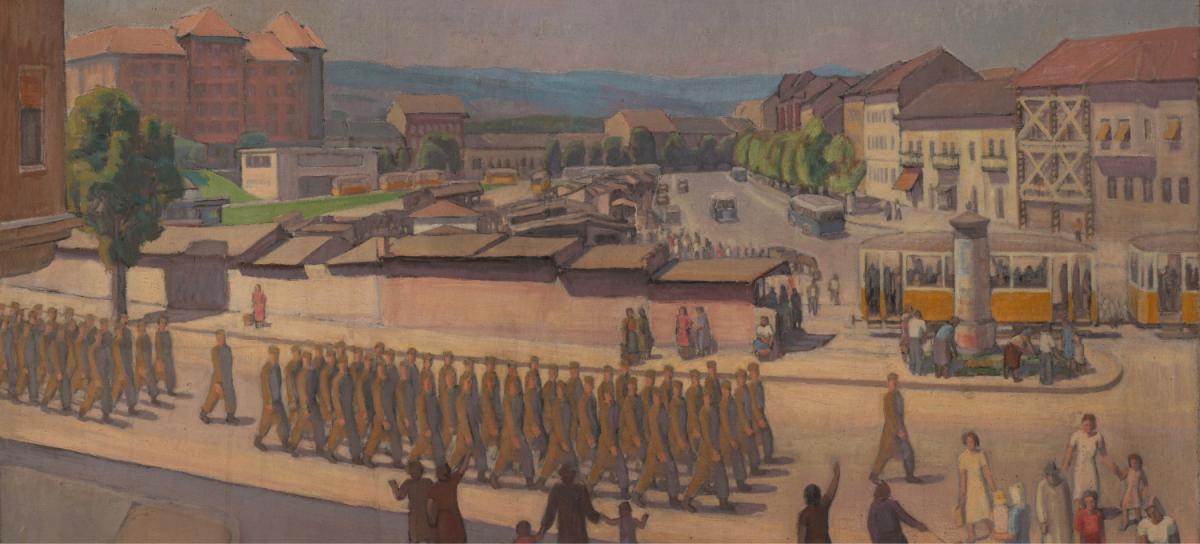
A Puzzle of Seventy-Seven + 7 Pieces – A Selection from the Collection of the Municipal Gallery
15. May 2025 – 31. January 2026
Curated by Anikó B. Nagy and Blanka Fábián
Location: 1st floor
The Baroque corridors and small rooms furnished with period pieces—characteristic spaces of the Kiscell Museum–provide a unique backdrop for the Municipal Gallery’s latest collection-based exhibition. A Puzzle of Seventy-Seven + 7 Pieces presents 77 pieces from our own collections together with 7 artworks invited from outside, spanning a wide range of periods and genres: paintings, prints, photographs, small sculptures, as well as objects linked to social campaigns—posters, badges, and pins.
As visitors move through the museum’s winding rooms, they encounter unexpected juxtapositions of historical and contemporary artworks. The exhibition establishes thematic relations and finely woven networks between these pieces—an organizing principle that the title itself reflects: the works eventually fit together like a puzzle.
The section titled Hard Times is the core of the exhibition which explores artistic reflections on war, dictatorships, and historical traumas of the 20th and 21st centuries. Placing pro-regime and critical works side by side creates a tension in space and raises urgent questions concerning artistic responsibility, collaboration and resistance, as well as the relationship between ethics and aesthetics.
The section Labelled showcases works by artists who have faced marginalization, exclusion or rejection due to their ethnic, religious or sexual identity. In Women’s Hands, visitors find artworks that reflect on forms of labour traditionally associated with women—often invisible, undervalued or unpaid—ranging from idealizing to critical and explicitly feminist perspectives. The section Montage condenses the exhibition’s curatorial logic in essence, bringing together diverse eras and viewpoints in an associative link.
In the end we return to where we began— the section Óbuda and Kiscell, conclude the exhibition with works that depict the museum’s surroundings, through past and present lenses.
A Puzzle of Seventy-Seven + 7 Pieces does not aim to tell a single, uniform story. Instead, it offers many parallel perspectives—in the spirit of contemporary museum thinking.